Impact Investing: 2026 Market & Social Change

The financial world is undergoing a profound transformation, shifting from traditional profit-at-all-costs models to a more holistic approach that integrates social and environmental considerations. At the forefront of this paradigm shift is impact investing growth, a dynamic and rapidly expanding sector that seeks to generate not only financial returns but also measurable positive social and environmental impact. This article delves into the exciting trajectory of impact investing, projecting its market size to reach an astounding $500 billion by 2026, and exploring how this monumental growth is driving tangible social change across the globe.
For too long, the realms of finance and philanthropy were seen as separate entities, operating under different mandates. Investors pursued financial gains, while philanthropists sought to address societal challenges. Impact investing bridges this gap, demonstrating that it is possible, and indeed increasingly desirable, to do both simultaneously. It represents a powerful convergence of purpose and profit, attracting a diverse array of investors from institutional funds and family offices to individual accredited investors who are keen to align their capital with their values.
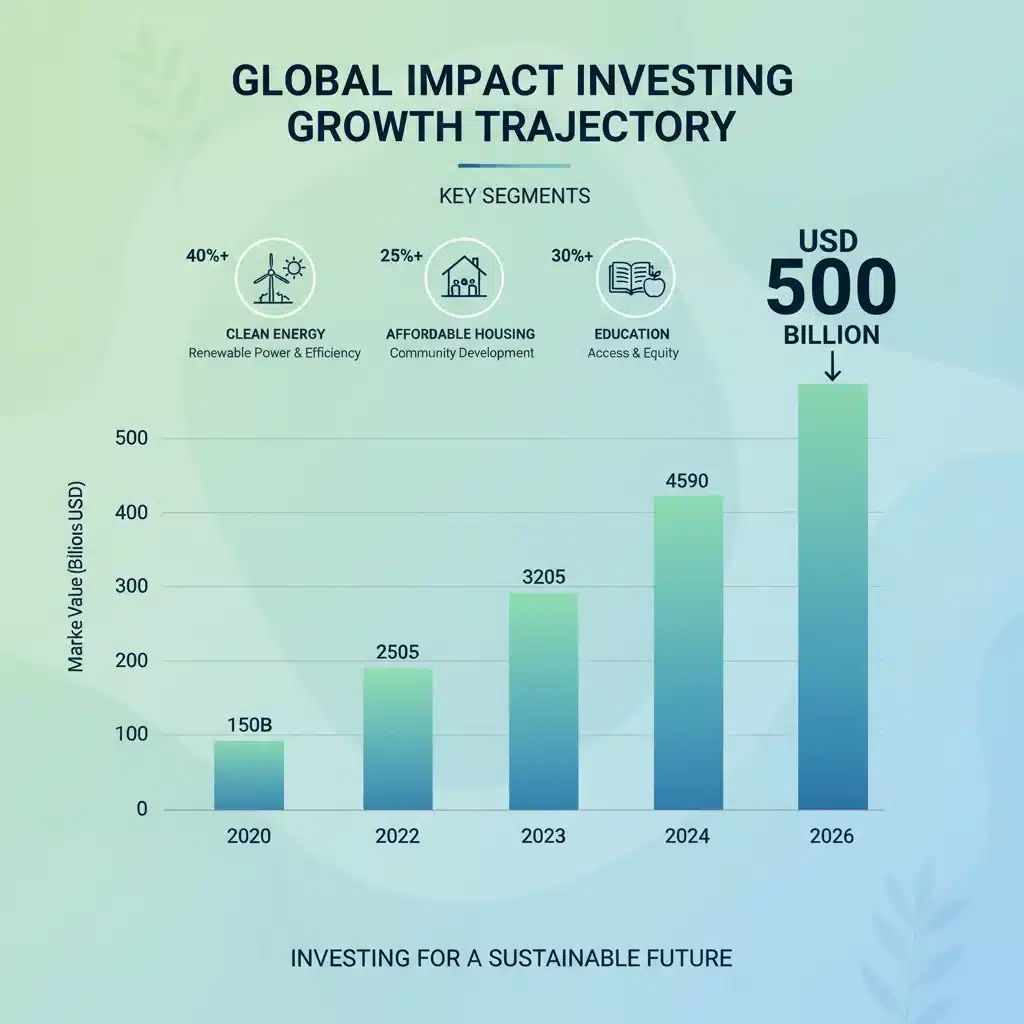
The concept of impact investing growth is not new, but its mainstream adoption and sophisticated methodologies have accelerated dramatically in recent years. What began as a niche area has blossomed into a significant force, propelled by a confluence of factors including rising awareness of global challenges, increasing demand for sustainable products and services, and a growing understanding that addressing these challenges can unlock significant economic opportunities. The projected $500 billion market by 2026 is a testament to this burgeoning momentum, signifying a future where conscious capital plays a central role in shaping a more equitable and sustainable world.
Understanding the Core Principles of Impact Investing
At its heart, impact investing is defined by three core characteristics:
- Intentionality: Impact investors explicitly intend to generate positive social and/or environmental impact through their investments. This is not merely a byproduct but a deliberate objective alongside financial returns.
- Financial Return: Unlike traditional philanthropy, impact investments are expected to generate a financial return, ranging from below-market to market-rate or even above-market returns, depending on the specific investment and investor objectives.
- Measurability: A crucial element of impact investing growth is the commitment to measure and report on the social and environmental performance of invested capital. This ensures accountability and helps investors understand the real-world effects of their decisions.
These principles differentiate impact investing from broader categories like Environmental, Social, and Governance (ESG) investing, which often focuses on risk mitigation and identifying financially material ESG factors, and socially responsible investing (SRI), which typically employs negative screening to exclude certain industries. While there can be overlaps, impact investing’s emphasis on intentionality and measurable impact sets it apart as a distinct and powerful force for good.
The scope of impact investing is vast, encompassing a wide range of sectors and asset classes. From affordable housing and education to clean energy, sustainable agriculture, and healthcare, impact investors are deploying capital to address critical global challenges outlined by the United Nations Sustainable Development Goals (SDGs). This broad applicability is a key driver of impact investing growth, as it allows investors to find opportunities that align with their specific impact interests and financial objectives.
Driving Forces Behind the $500 Billion Projection by 2026
Several significant trends are converging to fuel the projected surge in impact investing, pushing its market size towards the half-trillion-dollar mark by 2026. Understanding these drivers is crucial for grasping the future landscape of finance and the continued expansion of impact investing growth.
Millennial and Gen Z Influence
A new generation of investors, particularly millennials and Gen Z, are entering their prime earning and investing years with a distinct set of values. These demographics are keenly aware of global social and environmental issues and are increasingly seeking investments that reflect their personal ethics. Surveys consistently show that younger generations are more likely to prioritize impact alongside financial returns. As wealth transfers across generations, this demographic shift will continue to be a powerful catalyst for impact investing growth.
Growing Awareness of Systemic Risks and Opportunities
The COVID-19 pandemic, climate change, and growing social inequalities have highlighted the interconnectedness of global systems and the profound impact these issues can have on economic stability and human well-being. Investors are increasingly recognizing that neglecting social and environmental factors can pose significant risks to their portfolios. Conversely, investing in solutions to these challenges can unlock substantial market opportunities and foster long-term resilience. This dual understanding of risk mitigation and opportunity creation is a powerful engine for increased allocation to impact investments.
Policy and Regulatory Support
Governments and regulatory bodies worldwide are beginning to acknowledge the importance of sustainable finance. Initiatives like the European Union’s Sustainable Finance Disclosure Regulation (SFDR) and similar frameworks in other regions are creating greater transparency and providing clearer definitions for sustainable investments. While still evolving, this regulatory push is legitimizing the sector, attracting more institutional capital, and standardizing impact measurement, all of which contribute to accelerated impact investing growth.
Innovation in Financial Products and Technologies
The impact investing landscape is becoming increasingly sophisticated with the development of new financial instruments and technological advancements. Green bonds, social bonds, sustainability-linked loans, and impact funds catering to various risk-return profiles are making it easier for a broader range of investors to participate. Furthermore, advancements in data analytics and impact measurement technologies are improving the ability to track and report on impact, enhancing credibility and attracting more discerning investors. These innovations are crucial for sustaining the momentum of impact investing growth.
Corporate Engagement and ESG Integration
Beyond direct impact investments, there’s a growing trend of corporations integrating ESG principles into their core business strategies. This means that even traditional companies are becoming more conscious of their social and environmental footprint, creating a more fertile ground for impact-aligned businesses and supply chains. As companies increasingly prioritize purpose alongside profit, the ecosystem for impact investing expands, further driving its growth.
Key Sectors Benefiting from Impact Investing Growth
The versatility of impact investing allows it to address a multitude of global challenges. Several sectors are particularly ripe for significant capital deployment and are expected to see substantial transformative impact as the market approaches $500 billion by 2026.
Clean Energy and Climate Solutions
The urgency of climate change has made clean energy and climate solutions a cornerstone of impact investing. Investments in renewable energy (solar, wind, geothermal), energy efficiency technologies, sustainable transportation, carbon capture, and climate-resilient infrastructure are growing exponentially. These investments not only generate financial returns but also directly contribute to reducing greenhouse gas emissions, mitigating climate risks, and fostering energy independence. The transition to a low-carbon economy is a massive undertaking, and impact investing is playing a pivotal role in financing this global shift, solidifying its position as a key driver of impact investing growth.
Affordable Housing and Community Development
Access to safe, affordable housing is a fundamental human right, yet it remains a significant challenge globally. Impact investors are channeling capital into projects that develop and preserve affordable housing units, revitalize underserved communities, and provide access to essential services. These investments often involve partnerships with local governments and non-profit organizations, aiming to create sustainable, inclusive communities while generating stable, long-term financial returns. This focus on foundational societal needs is a powerful aspect of impact investing growth.
Sustainable Agriculture and Food Systems
Feeding a growing global population while preserving natural resources presents a complex challenge. Impact investments in sustainable agriculture focus on practices that enhance soil health, conserve water, reduce pesticide use, and promote biodiversity. This includes supporting organic farming, vertical farms, precision agriculture technologies, and ethical supply chains. The goal is to create more resilient, equitable, and environmentally friendly food systems that deliver both nutritional and financial benefits. The transformation of food systems is an area ripe for continued impact investing growth.
Education and Workforce Development
Investing in human capital is crucial for sustainable development. Impact investors are supporting initiatives that improve access to quality education, particularly for marginalized communities. This includes funding for innovative educational technologies, vocational training programs, early childhood development initiatives, and scholarships. By enhancing educational opportunities and workforce skills, these investments aim to reduce inequality, promote economic mobility, and foster a more skilled and adaptable global workforce. This commitment to human potential is a core element of impact investing growth.
Healthcare Access and Innovation
Ensuring equitable access to quality healthcare for all is a pressing global concern. Impact investors are deploying capital into ventures that develop affordable medical devices, expand healthcare infrastructure in underserved regions, support telemedicine solutions, and create innovative approaches to disease prevention and treatment. These investments aim to improve health outcomes, reduce healthcare disparities, and build more resilient public health systems, contributing significantly to positive social impact and driving further impact investing growth.
Measuring and Reporting Impact: The Gold Standard
For impact investing growth to be sustainable and credible, robust frameworks for measuring and reporting impact are essential. This is where the field has seen significant advancements. Investors and organizations are increasingly adopting standardized metrics and methodologies to ensure that the stated impact is verifiable and attributable to the investment.
Key Impact Measurement Frameworks
- IRIS+ (Impact Reporting and Investment Standards): Developed by the Global Impact Investing Network (GIIN), IRIS+ provides a comprehensive catalog of generally accepted performance metrics that are used by impact investors to describe their social, environmental, and financial performance.
- Sustainable Development Goals (SDGs): The 17 SDGs provide a universal framework for impact investors to align their investments with global development priorities. Many impact funds and organizations now map their impact to specific SDG targets.
- Impact Management Project (IMP): The IMP has created a common language and framework for understanding and managing impact, helping investors to articulate what impact they are seeking to achieve and how they intend to get there.
- B Corp Certification: While not strictly an investment framework, B Corp certification provides a rigorous assessment of a company’s social and environmental performance, governance, and transparency, often making B Corps attractive targets for impact investors.
The ability to effectively measure and communicate impact is not just about accountability; it also drives learning and improvement. By understanding what works and what doesn’t, investors can refine their strategies, allocate capital more effectively, and ultimately amplify their positive contributions. This commitment to transparency and results is a critical factor in the continued expansion of impact investing growth.

Challenges and Opportunities on the Path to $500 Billion
While the trajectory for impact investing growth is undeniably positive, the journey to a $500 billion market by 2026 is not without its challenges. Addressing these hurdles will be crucial for realizing the full potential of this transformative financial movement.
Challenges:
- Lack of Standardized Metrics: Despite advancements, a universally accepted set of impact metrics remains elusive, making it challenging to compare impact across different investments and sectors. This can deter some mainstream investors.
- Data Availability and Quality: Collecting robust, reliable impact data, especially from early-stage ventures or in developing markets, can be difficult and resource-intensive.
- “Impact Washing”: The rise of interest in impact investing has unfortunately led to some instances of “impact washing,” where investments are marketed as impactful without genuine intent or measurable results. This erodes trust and necessitates stronger due diligence.
- Scalability of Deal Flow: While capital is increasingly available, finding a sufficient pipeline of high-quality, scalable impact investment opportunities, particularly for larger institutional investors, can still be a challenge.
- Perceived Trade-off Between Impact and Financial Return: A persistent misconception is that generating impact necessarily means sacrificing financial returns. While some impact investments may target concessionary returns, many aim for, and achieve, market-rate or even above-market returns. Educating investors on this reality is ongoing.
Opportunities:
- Mainstream Adoption: As more large financial institutions, pension funds, and sovereign wealth funds enter the space, the scale and sophistication of impact investing will increase dramatically.
- Blended Finance: Combining public, philanthropic, and private capital through blended finance structures can de-risk investments and attract private capital to projects that might otherwise be deemed too risky or not financially viable.
- Technological Solutions: AI, blockchain, and other emerging technologies can revolutionize impact measurement, reporting, and due diligence, making the process more efficient and transparent.
- Emerging Markets Focus: Developing economies often present the greatest needs and opportunities for impact, particularly in sectors like renewable energy, healthcare, and financial inclusion.
- Policy Innovation: Continued governmental support, tax incentives, and regulatory clarity can further accelerate the growth and effectiveness of impact investing.
Overcoming these challenges and capitalizing on these opportunities will be paramount for sustaining the rapid pace of impact investing growth and ensuring its long-term success in driving meaningful social and environmental change.
The Future Landscape: Beyond 2026
The projected $500 billion market by 2026 is not an endpoint but rather a significant milestone in the broader evolution of finance. Looking beyond this horizon, impact investing is poised to become an even more integral part of the global financial system. The lines between conventional investing and impact investing are likely to blur further, with ESG factors and impact considerations becoming standard practice across all asset classes.
We can anticipate greater integration of impact data into financial modeling and investment decision-making. The development of sophisticated tools and platforms will allow investors to seamlessly evaluate both financial performance and social/environmental impact, fostering a more holistic approach to capital allocation. The rise of new investment vehicles, such as outcome-based financing and pay-for-success models, will also continue to innovate how capital is deployed to solve complex societal problems.
Furthermore, as the world grapples with increasingly complex and interconnected challenges – from climate migration to future pandemics – the need for capital that intentionally generates positive solutions will only intensify. Impact investing, with its inherent focus on solutions and measurable results, is uniquely positioned to meet these demands. The continued impact investing growth will be driven by a collective realization that sustainable development and long-term financial prosperity are inextricably linked.
The role of individual investors will also expand. As access to impact investment opportunities becomes more democratized through platforms and accessible funds, more individuals will be able to align their personal values with their investment portfolios, collectively contributing to a significant pool of capital dedicated to positive change.
Conclusion: A New Era of Conscious Capital
The journey towards a $500 billion impact investing market by 2026 represents a pivotal moment in the history of finance. It signifies a profound shift towards conscious capital, where financial prowess is harnessed to address the world’s most pressing social and environmental challenges. This remarkable impact investing growth is not just about numbers; it’s about the tangible improvements in lives, communities, and ecosystems that these investments facilitate.
From powering homes with clean energy to providing quality education, ensuring access to healthcare, and fostering sustainable food systems, impact investing is proving that financial returns and positive societal impact are not mutually exclusive but rather mutually reinforcing. As investors, entrepreneurs, policymakers, and civil society organizations continue to collaborate and innovate, the future of finance will undoubtedly be more purposeful, more inclusive, and ultimately, more impactful.
The evolution of impact investing is a testament to humanity’s capacity to innovate and adapt, channeling resources towards a future that is both prosperous and sustainable. The projected growth is a clear indicator that the world is moving towards a financial system that values not just wealth creation, but also well-being and planetary health. Embracing this trend is not just an ethical choice; it is an intelligent investment strategy for the 21st century and beyond. The momentum of impact investing growth is undeniable, promising a brighter, more equitable future for all.