Generative AI in Content Creation: Mastering New U.S. Copyright Challenges by March 2026 (TIME-SENSITIVE, PRACTICAL SOLUTIONS)
Generative AI in Content Creation: Mastering New U.S. Copyright Challenges by March 2026 (TIME-SENSITIVE, PRACTICAL SOLUTIONS)
The landscape of content creation is undergoing a seismic shift, driven by the exponential advancements in generative artificial intelligence (AI). From crafting compelling narratives and designing stunning visuals to composing intricate musical pieces, AI tools are empowering creators and businesses to produce content at unprecedented scales and speeds. However, this technological marvel introduces a complex web of legal questions, particularly concerning U.S. copyright law. With regulatory bodies and courts actively grappling with these novel issues, the period leading up to March 2026 is critical for understanding and adapting to the evolving legal framework. Failing to prepare could expose individuals and organizations to significant legal risks, including infringement claims and costly litigation. This comprehensive guide delves into the intricate relationship between generative AI and U.S. copyright law, offering practical solutions and strategic insights to help content creators, businesses, and legal professionals navigate these challenges effectively and ensure compliance.
The Generative AI Revolution: A Brief Overview
Generative AI refers to a class of artificial intelligence algorithms capable of producing novel content, such as text, images, audio, and video, that often mimics human creativity. Unlike traditional AI that primarily analyzes and processes existing data, generative models like Large Language Models (LLMs) and diffusion models can learn from vast datasets to create original outputs. This capability has profound implications across various industries, including marketing, entertainment, software development, and education.
For content creators, generative AI offers a powerful toolkit to augment their capabilities. Writers can overcome writer’s block with AI-generated drafts, designers can rapidly prototype ideas, and marketers can personalize content at scale. Businesses leverage AI to streamline content pipelines, reduce production costs, and accelerate time-to-market. The allure of efficiency and innovation is undeniable, but it comes with a critical caveat: the legal implications of using and creating with these powerful tools are still being defined, especially concerning intellectual property rights.
Understanding the fundamental nature of generative AI — its ability to learn from and synthesize existing works — is the first step toward appreciating the complexity of the copyright issues it presents. The ‘training data’ used to develop these models often consists of vast amounts of copyrighted material, raising questions about unauthorized reproduction and derivative works. Furthermore, the ‘originality’ and ‘authorship’ of AI-generated content are central to determining its copyright eligibility, a concept traditionally reserved for human creators.
U.S. Copyright Law Fundamentals in the Age of AI
To grasp the challenges posed by generative AI, it’s essential to revisit the core tenets of U.S. copyright law. Copyright protects original works of authorship fixed in a tangible medium of expression. Key elements include:
- Originality: The work must be independently created by a human author and possess at least a modicum of creativity.
- Authorship: Traditionally, copyright vests in the human creator of the work.
- Fixed in a Tangible Medium: The work must be embodied in a physical form from which it can be perceived, reproduced, or otherwise communicated.
The U.S. Copyright Office (USCO) has historically maintained that copyright protection is limited to works created by human beings. This stance is rooted in constitutional interpretations and decades of legal precedent. However, generative AI blurs these lines considerably. When an AI system generates content, who is the author? Is it the programmer, the user who prompts the AI, or the AI itself? The current legal framework struggles to accommodate a non-human author.
Key Areas of Conflict and Uncertainty:
- Training Data and Fair Use: Generative AI models are trained on massive datasets, often scraped from the internet, which include copyrighted works. Is this training process considered copyright infringement? Proponents of AI argue that it constitutes fair use, akin to a human reading countless books to learn and develop their own creative style. Opponents contend that it involves unauthorized reproduction of copyrighted material, especially when the AI output closely resembles elements of its training data. The legal debate around fair use in this context is ongoing and highly contentious.
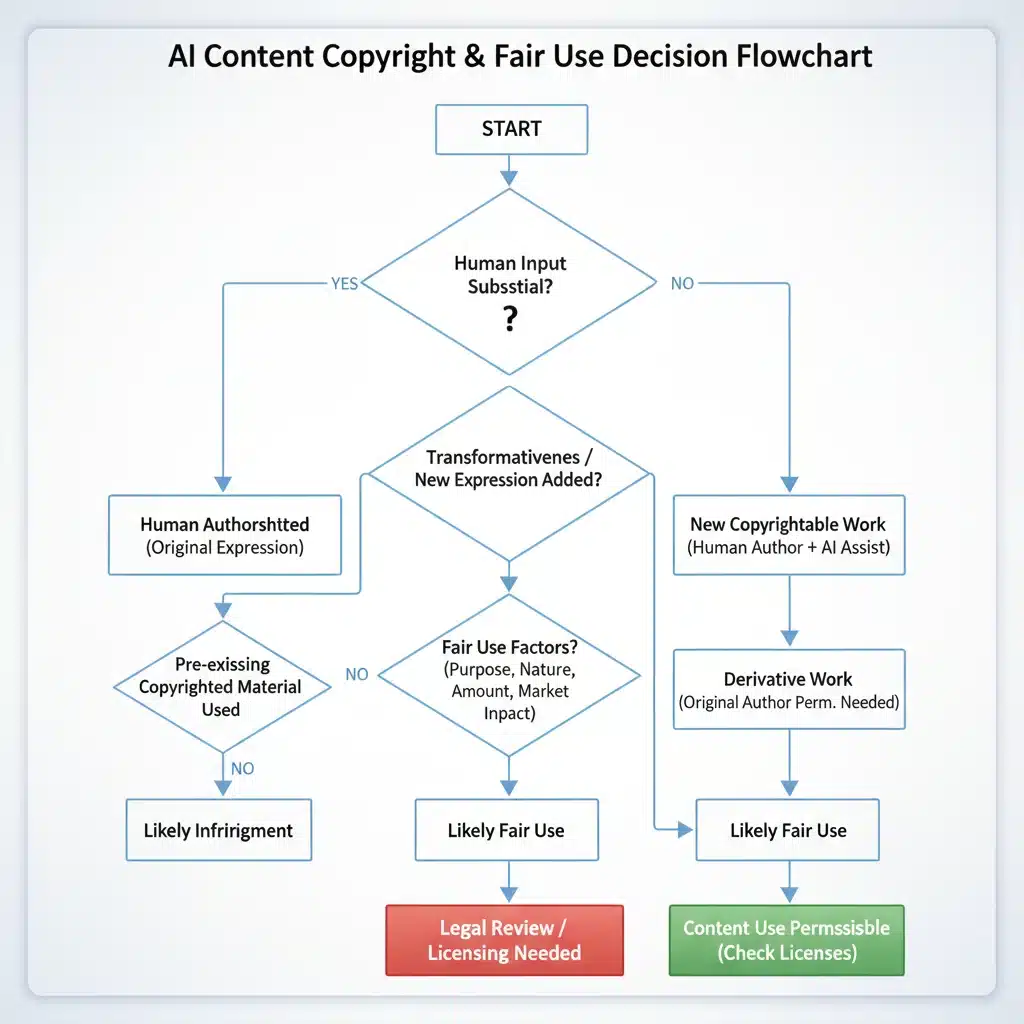
- Authorship and Originality of AI-Generated Content: If an AI creates a novel image or text, can it be copyrighted? The USCO has consistently denied copyright registration for works solely created by AI without significant human input. The current guidance requires a human author to exercise creative control over the AI’s output, shaping it and making independent creative choices. This raises questions about what level of human intervention is sufficient to claim authorship.
- Derivative Works and Substantial Similarity: When AI-generated content is similar to existing copyrighted works, it raises concerns about derivative works and substantial similarity. If an AI generates an image that is substantially similar to a copyrighted photograph, could it be considered an infringing derivative work? This is a particular concern when AI models are prompted to mimic specific styles or artists.
- Liability for Infringement: Who is liable if AI-generated content infringes on existing copyrights? Is it the developer of the AI model, the platform hosting the AI, or the user who prompted the AI? This question is central to risk management for businesses and individuals utilizing generative AI.
These complex issues underscore the urgent need for clarity and adaptation within the legal system. The USCO has initiated studies and public consultations, and courts are beginning to hear cases that will shape future interpretations of copyright law in the AI era.
The Road to March 2026: What to Expect
The period leading up to March 2026 is critical because it represents a likely timeframe for significant developments in U.S. copyright law concerning generative AI. This projection is based on several factors:
- U.S. Copyright Office Guidance: The USCO has been actively engaging with stakeholders and has already issued initial guidance on AI and copyright registration. They are expected to provide more comprehensive rules and interpretations as they gather more information and as court cases provide clearer precedents.
- Legislative Efforts: There are ongoing discussions in Congress about potential legislation to address AI copyright issues. While legislative processes can be slow, the growing economic and cultural impact of AI is likely to accelerate these efforts.
- Key Court Decisions: Several high-profile lawsuits involving generative AI and copyright infringement are currently making their way through the U.S. court system (e.g., cases against Stability AI, Midjourney, OpenAI). Decisions in these cases, particularly at the appellate level, will set important precedents and clarify legal interpretations.
- International Harmonization: As AI is a global phenomenon, international discussions and agreements on intellectual property will also influence U.S. policy and vice versa.
By March 2026, we can anticipate a more defined legal landscape, potentially including updated USCO regulations, new judicial precedents, or even specific legislation. This makes proactive preparation not just advisable, but essential.
Practical Solutions for Content Creators and Businesses
Navigating the evolving legal terrain requires a proactive and informed approach. Here are practical strategies for content creators and businesses utilizing generative AI:
1. Understand and Document Human Authorship
Given the USCO’s stance on human authorship, it is paramount to ensure and document significant human creative input when using generative AI. If you intend to seek copyright protection for your AI-assisted work, you must be able to demonstrate that a human made creative decisions that shaped the final output.
- Creative Control: Do not simply accept AI output verbatim. Modify, select, arrange, or enhance the AI-generated content. Document your iterative process, showing how your creative choices transformed the initial AI output into a distinct work.
- Prompt Engineering as Creative Input: While prompting an AI is a form of instruction, the USCO generally considers it insufficient on its own for authorship. However, highly detailed, iterative, and creatively directed prompting, combined with subsequent human editing and selection, can contribute to demonstrating creative control. Keep records of your prompts and the evolution of your creative vision.
- Hybrid Works: Clearly delineate human-created elements from AI-generated elements in your work. If you integrate AI-generated components into a larger human-authored work, you can typically claim copyright over the human-authored portions and the selection/arrangement of the combined work.
2. Implement Robust Licensing and Usage Policies for Training Data
For developers of generative AI models, or businesses that train custom models, the legality of training data acquisition is a critical concern.
- Licensed Datasets: Prioritize using datasets that are explicitly licensed for training AI models. This might involve purchasing data, using public domain materials, or obtaining specific permissions from copyright holders.
- Opt-Out Mechanisms: Respect requests from copyright holders to opt their works out of training datasets. Some AI companies are beginning to implement such mechanisms.
- Data Governance: Establish clear internal policies for data acquisition, storage, and usage to minimize legal risks. Conduct thorough due diligence on all training data sources.
3. Due Diligence on AI-Generated Output
Before publishing or commercializing AI-generated content, perform thorough checks to avoid infringement.
- Similarity Checks: Utilize tools and human review to check AI outputs for substantial similarity to existing copyrighted works. This is particularly crucial for visual content, music, and distinct literary styles.
- Style Mimicry: Be cautious when prompting AI to generate content in the style of specific artists or authors, as this can increase the risk of creating infringing derivative works.
- Attribution and Disclaimers: When appropriate, disclose the use of AI in content creation. This promotes transparency and can help manage expectations regarding originality and authorship, though it does not absolve liability for infringement.
4. Review and Update Contracts and Agreements
Existing contracts may not adequately address the complexities introduced by generative AI. It’s crucial to review and update agreements with employees, contractors, clients, and AI service providers.
- Employee/Contractor Agreements: Clearly define ownership of AI-assisted works created by employees or freelancers. Specify expectations regarding the use of AI tools and compliance with copyright policies.
- Client Contracts: Address the use of AI in deliverables, intellectual property ownership, and indemnification for potential infringement claims.
- AI Service Provider Terms of Service: Understand the IP rights granted by AI tools. Do they claim ownership of your prompts or outputs? Do they indemnify you against infringement claims arising from their models? These terms vary widely among providers.
5. Stay Informed and Engage with Policy Developments
The legal landscape is fluid. Continuous monitoring of developments is essential.
- Follow the US Copyright Office: Regularly check their official website for new guidance, reports, and public consultations.
- Monitor Case Law: Keep an eye on significant court decisions related to AI and copyright. Legal news outlets and specialized IP law blogs are excellent resources.
- Participate in Industry Discussions: Engage with industry groups, legal professionals, and policy forums to contribute to and understand evolving best practices.
6. Consider AI-Specific IP Policies and Audits
For organizations heavily reliant on generative AI, developing internal AI-specific intellectual property policies is a strategic imperative.
- Internal Guidelines: Create clear guidelines for employees on acceptable use of generative AI, including data input, output review, and IP compliance.
- Regular Audits: Conduct periodic audits of AI-generated content and associated workflows to identify and mitigate potential copyright risks.
- Training: Provide training to content creators, marketing teams, and legal departments on the nuances of AI copyright law and internal policies.
Case Studies and Emerging Precedents
While the legal framework is still evolving, a few significant cases and actions by the U.S. Copyright Office offer early insights:
- Thaler v. Perlmutter (2023): Stephen Thaler attempted to register a copyright for an image created by his AI system, ‘Creativity Machine,’ listing the AI as the author. The USCO and subsequently the U.S. District Court for the District of Columbia affirmed the rejection, reiterating that human authorship is a prerequisite for copyright protection. This case firmly establishes the current legal stance that AI alone cannot be an author.
- Zarya of the Dawn (2022): Kristina Kashtanova successfully registered copyright for a graphic novel, ‘Zarya of the Dawn,’ which featured AI-generated images created using Midjourney. However, the USCO later clarified that while the text and the selection/arrangement of the images were copyrightable as human contributions, the individual AI-generated images themselves, to the extent they were not creatively modified by Kashtanova, were not. This case highlights the distinction between human-authored elements and raw AI output.
- Artist Lawsuits Against AI Companies: Several artists have filed class-action lawsuits against generative AI companies like Stability AI, Midjourney, and DeviantArt, alleging that their AI models were trained on copyrighted works without permission, constituting infringement. These cases are pivotal in determining the legality of using copyrighted material for AI training and the application of fair use doctrine in this context. Their outcomes will profoundly influence the future of AI development and content creation.
These early precedents underscore the importance of human creative input for copyright protection and signal a cautious approach by legal authorities toward AI-generated content. They also emphasize the growing legal scrutiny on the data used to train AI models.
The Ethical Dimension: Beyond Legal Compliance
While legal compliance is paramount, the use of generative AI also raises significant ethical considerations that content creators and businesses should address. These ethical dilemmas often precede and influence legal developments.
- Attribution and Credit: Even if not legally mandated, transparently attributing AI’s role in content creation can build trust with audiences and respect the contributions (or lack thereof) of human artists.
- Bias and Representation: Generative AI models can perpetuate and amplify biases present in their training data. Creators must be mindful of potential biases in AI outputs and take steps to mitigate them, ensuring responsible and inclusive content creation.
- Displacement of Human Labor: The increasing capability of AI raises concerns about job displacement in creative industries. Companies should consider ethical guidelines for integrating AI that support human creativity rather than solely replacing it.
- Authenticity and Deepfakes: The ability of AI to generate highly realistic but fabricated content (deepfakes) poses risks related to misinformation, reputation damage, and fraud. Ethical frameworks are crucial for responsible AI deployment.
Adopting an ethical framework for AI usage not only fosters a responsible creative environment but can also act as a buffer against future legal challenges, demonstrating a commitment to fair practices.
Conclusion: Proactive Adaptation is Key
The convergence of generative AI and U.S. copyright law presents an exciting yet challenging frontier for content creators and businesses. The period leading up to March 2026 is not merely a waiting game; it is a critical window for proactive adaptation, strategic planning, and informed decision-making. The current legal framework, while grappling with new technologies, consistently emphasizes human authorship and creative control as cornerstones of copyright protection.
To thrive in this evolving landscape, stakeholders must:
- Prioritize human creative input in AI-assisted workflows and meticulously document their contributions.
- Conduct thorough due diligence on both AI training data and AI-generated outputs to mitigate infringement risks.
- Regularly review and update legal agreements to reflect the realities of AI integration.
- Stay abreast of legal and policy developments from the U.S. Copyright Office and relevant court cases.
- Embrace ethical considerations alongside legal compliance, fostering responsible and sustainable AI use.
By adopting these practical solutions, content creators and businesses can not only navigate the complex U.S. copyright challenges posed by generative AI but also position themselves to innovate responsibly and securely in the rapidly advancing digital age. The future of content creation is collaborative, blending human ingenuity with AI’s powerful capabilities, but success hinges on understanding and respecting the legal and ethical boundaries that define our creative ecosystem.