Micro-Frontends in 2026: Scalable Web Development Benefits Explored

The Rise of Micro-Frontends in 2026: 3 Key Benefits for Scalable Web Development
The digital landscape is in perpetual motion, an ever-evolving tapestry of innovation and transformation. As we look towards 2026, one architectural paradigm stands poised to redefine the way we conceive, build, and maintain complex web applications: Micro-Frontends. This paradigm, a natural evolution from the success of microservices on the backend, promises to bring similar levels of agility, scalability, and resilience to the client-side of web development. For organizations striving to remain competitive, deliver exceptional user experiences, and accelerate their development cycles, understanding and adopting Micro-Frontends Scalable Web strategies will not merely be an advantage, but a necessity.
In an era where user expectations are higher than ever, and applications demand continuous updates, feature parity, and seamless integration, the traditional monolithic frontend architecture often buckles under the pressure. Dependencies become entangled, deployment cycles slow to a crawl, and scaling individual components becomes a Herculean task. This is precisely where Micro-Frontends step in, offering a decentralized, domain-driven approach to frontend development that empowers independent teams and fosters a culture of innovation.
This comprehensive article will delve into the profound impact of Micro-Frontends Scalable Web architectures, exploring their fundamental principles and dissecting the three pivotal benefits that are driving their widespread adoption. We will examine how they enhance team autonomy and accelerate delivery, bolster application resilience and fault isolation, and provide unparalleled technological flexibility. By the end of this exploration, you will have a clear understanding of why Micro-Frontends are not just a fleeting trend, but a foundational shift in how we approach scalable web development in 2026 and beyond.
Understanding the Micro-Frontend Paradigm: A Shift Towards Modularity
Before we dive into the specific benefits, it’s crucial to grasp the core concept of Micro-Frontends. Imagine a large, intricate web application – an e-commerce platform, a banking portal, or a sophisticated analytics dashboard. Traditionally, such an application would be built as a single, cohesive frontend unit, often managed by a large, centralized team. While this approach has its merits for smaller projects, it quickly becomes a bottleneck as applications grow in complexity and team size.
Micro-Frontends, in essence, extend the microservices philosophy to the frontend. Instead of a single, monolithic user interface, the application is composed of multiple, smaller, independently deployable frontend applications. Each of these ‘micro-frontends’ represents a distinct business capability or domain, such as a product catalog, user authentication, a shopping cart, or a payment gateway. Each micro-frontend can be developed, tested, and deployed by a small, autonomous team, using their preferred technology stack.
This architectural shift moves away from the ‘big ball of mud’ syndrome often associated with large frontend monoliths. It breaks down the frontend into manageable, self-contained units, fostering a distributed ownership model. The integration of these micro-frontends can happen at various levels: build time, run time, or even through server-side composition. The key is that each unit functions as a distinct entity, communicating with others through well-defined APIs, much like microservices interact on the backend.
The adoption of Micro-Frontends Scalable Web solutions requires a thoughtful approach to team organization, communication, and infrastructure. It’s not just about technology; it’s about a fundamental change in how development teams operate and collaborate. This modularity isn’t just an aesthetic choice; it’s a strategic decision that underpins the significant benefits we will now explore.
Benefit 1: Enhanced Team Autonomy and Accelerated Delivery Cycles
One of the most compelling advantages of adopting Micro-Frontends Scalable Web architecture in 2026 is the profound impact it has on team autonomy and the subsequent acceleration of delivery cycles. In a monolithic frontend, even a small change in one part of the application can necessitate a full redeployment of the entire frontend. This creates tightly coupled teams, where dependencies on other teams for testing, integration, and release management often lead to delays and frustration.
With Micro-Frontends, each team is responsible for a specific, isolated part of the user interface. This means:
- Independent Development: Teams can develop features in their micro-frontend without impacting or being blocked by other teams. They control their own codebase, build pipeline, and testing strategy.
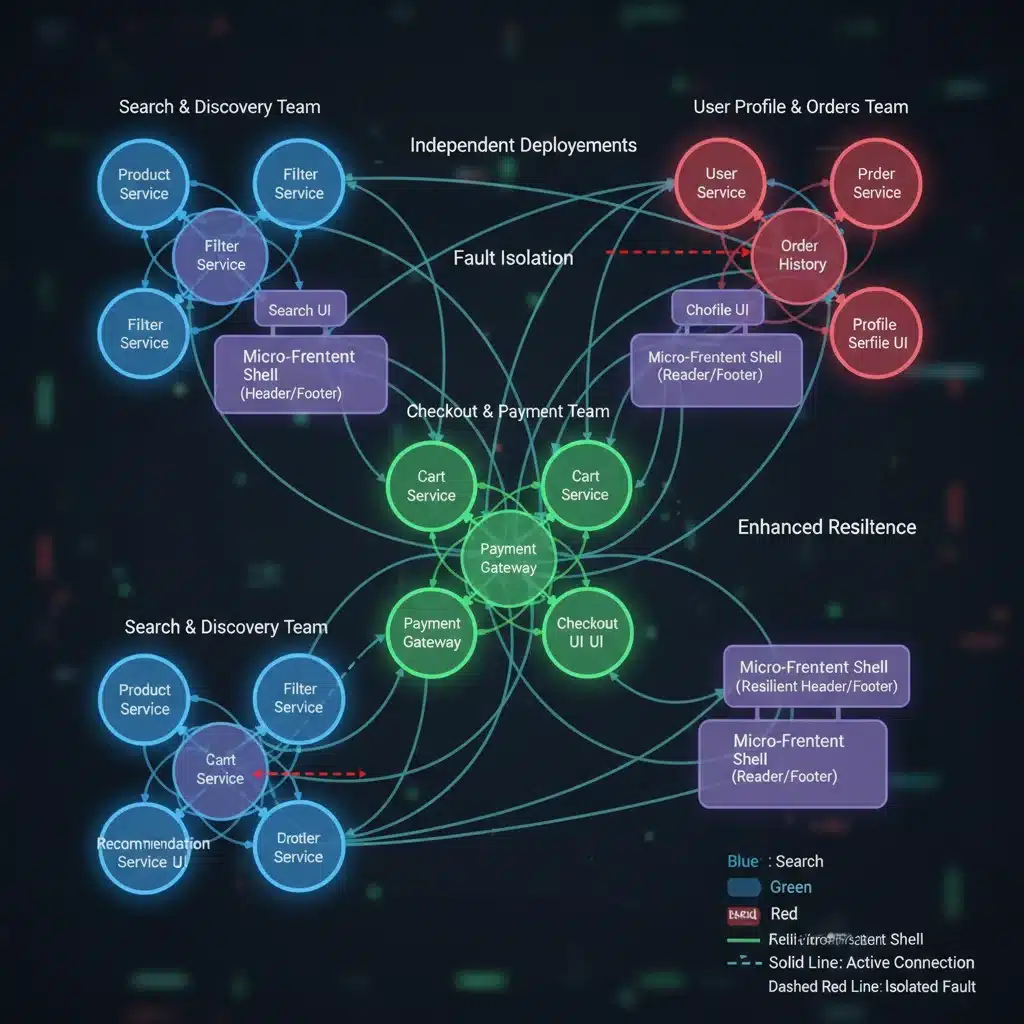
- Independent Deployment: A team can deploy their micro-frontend to production without requiring other teams to be ready or to redeploy their components. This significantly reduces the risk associated with deployments and allows for more frequent releases. Imagine deploying a new feature for the shopping cart without touching the product display or user profile sections – this level of agility is a game-changer.
- Reduced Coordination Overhead: The need for extensive cross-team coordination meetings and dependency management is drastically reduced. Teams can focus on their specific domain, leading to increased productivity and ownership.
- Faster Time-to-Market: The ability to develop and deploy features independently translates directly into faster time-to-market for new functionalities and updates. Businesses can respond more rapidly to market demands and user feedback, gaining a significant competitive edge.
Consider a large enterprise with multiple product lines, each requiring a dedicated team. In a monolithic setup, integrating features from each product into a single frontend often becomes a logistical nightmare. Micro-Frontends, however, allow each product team to own and evolve their respective frontend components independently, integrating them seamlessly into a unified user experience. This distributed ownership fosters a sense of responsibility and accelerates innovation within each team.
This enhanced autonomy is not just about speed; it’s about empowering developers. When teams have full control over their domain, they are more engaged, more innovative, and ultimately, more productive. This leads to a higher quality of code and a more robust application in the long run. The shift to Micro-Frontends Scalable Web development is as much about organizational design as it is about technical architecture, fostering a culture of ownership and continuous delivery.

Benefit 2: Enhanced Application Resilience and Fault Isolation
Another critical benefit that positions Micro-Frontends Scalable Web architectures as a cornerstone for future web development is their inherent ability to enhance application resilience and provide robust fault isolation. In a monolithic frontend, a single bug or performance issue in one component can potentially bring down the entire application, leading to a degraded user experience or even complete service unavailability.
Micro-Frontends mitigate this risk significantly:
- Containment of Failures: If one micro-frontend encounters an error or performance bottleneck, it is largely isolated from other micro-frontends. For example, if the recommendation engine micro-frontend fails, the user can still browse products, add items to their cart, and proceed to checkout, albeit without personalized recommendations. The core functionality of the application remains intact.
- Graceful Degradation: This fault isolation enables graceful degradation. Instead of a complete outage, users might experience a partially degraded service, which is far preferable to a full system crash. The failing component can be quickly identified and addressed without affecting the entire user interface.
- Independent Scaling: While primarily a backend concern, the concept of independent scaling also applies to frontend components. If a particular part of the UI experiences exceptionally high traffic (e.g., a flash sale on a specific product category), only that micro-frontend needs to be scaled up, rather than the entire application. This optimizes resource utilization and maintains performance under stress.
- Faster Recovery: When an issue does arise, the smaller, isolated nature of micro-frontends makes it easier and faster to diagnose and fix. A targeted hotfix can be deployed to the affected micro-frontend without requiring a full regression test of the entire application.
Consider a complex financial trading platform. If the real-time stock ticker module experiences a transient network issue, in a monolithic architecture, this could potentially freeze the entire trading interface. With Micro-Frontends Scalable Web design, the stock ticker micro-frontend might display a ‘data unavailable’ message, but the user can still access their portfolio, execute trades, and manage their orders through other, unaffected micro-frontends. This level of resilience is paramount for mission-critical applications where downtime translates directly to financial losses or reputational damage.
The ability to isolate faults and ensure that a problem in one area doesn’t cascade throughout the entire application is a powerful argument for adopting Micro-Frontends. It leads to a more stable, reliable, and ultimately, a more trustworthy application for end-users, enhancing their confidence and satisfaction. This robustness is a key differentiator for businesses operating in highly competitive digital markets.
Benefit 3: Unparalleled Technological Flexibility and Innovation
The third major benefit driving the adoption of Micro-Frontends Scalable Web architectures by 2026 is the unparalleled technological flexibility they offer. In a traditional monolithic frontend, once a technology stack is chosen (e.g., React, Angular, Vue.js), the entire application is typically bound to that choice. This can lead to several challenges:
- Legacy Code Maintenance: As frameworks evolve, maintaining older versions of a large monolith can become increasingly difficult and costly. Upgrading the entire application to a new major version of a framework is often a massive, risky undertaking.
- Talent Acquisition: Being locked into a single technology stack can limit an organization’s ability to attract and retain top talent, as many developers prefer working with modern, diverse technologies.
- Innovation Stifling: Experimentation with new frameworks or libraries is severely hampered. Introducing a new technology into a large monolith is often deemed too risky or too complex.
Micro-Frontends elegantly address these issues by allowing each micro-frontend to be built using its own preferred technology stack. This ‘polyglot frontend’ approach means:
- Freedom of Choice: Different teams can choose the best technology for their specific domain or even experiment with newer frameworks without affecting other parts of the application. One team might use React for a highly interactive component, while another uses Vue.js for a more static content display.
- Easier Upgrades and Migrations: Instead of a daunting, all-at-once migration, legacy parts of an application can be gradually refactored or rewritten as new micro-frontends using modern technologies. This allows for incremental modernization, reducing risk and cost.
- Attracting Diverse Talent: By supporting multiple technologies, organizations can appeal to a broader range of developers, fostering a more diverse and skilled workforce.
- Continuous Innovation: Teams are empowered to innovate and adopt new tools and techniques more readily. This keeps the development process fresh and ensures the application remains at the cutting edge of web technology.
Imagine a scenario where a company has a legacy customer portal built with an older version of Angular. Rather than undertaking a massive, risky rewrite of the entire portal to a newer framework, they can gradually introduce new features as micro-frontends built with React. Over time, the legacy Angular components can be replaced one by one, providing a smooth transition and minimizing disruption. This evolutionary approach to architecture is a hallmark of intelligent, sustainable software development.
This technological flexibility is not just about using the latest and greatest tools; it’s about strategic agility. It allows businesses to adapt their technology stack to meet evolving business needs and market conditions, ensuring their applications remain performant, maintainable, and competitive. The adoption of Micro-Frontends Scalable Web patterns empowers innovation at every level of the development process.
Challenges and Considerations for Adopting Micro-Frontends
While the benefits of Micro-Frontends Scalable Web architectures are significant, it’s essential to acknowledge that this paradigm is not a silver bullet and comes with its own set of challenges. Organizations considering this shift must be prepared to address these complexities to ensure a successful implementation.
- Increased Operational Complexity: Managing multiple independent applications, each with its own build, test, and deployment pipeline, inevitably adds operational overhead. This requires robust CI/CD practices, effective monitoring, and potentially new tooling to orchestrate the various micro-frontends.
- Consistent User Experience and Design: Ensuring a cohesive and consistent user experience across multiple micro-frontends, developed by different teams, can be challenging. A strong design system, shared component libraries, and clear communication guidelines are crucial to prevent a fragmented look and feel.
- Inter-Micro-Frontend Communication: Defining clear and efficient communication strategies between micro-frontends is vital. This often involves event-driven architectures, shared state management solutions, or careful API design. Over-reliance on direct communication can reintroduce coupling.
- Performance Considerations: While individual micro-frontends can be optimized, the overhead of loading and orchestrating multiple bundles can sometimes impact initial page load performance. Strategies like server-side rendering (SSR), client-side caching, and intelligent lazy loading become even more important.
- Team Structure and Culture: Successfully implementing Micro-Frontends often requires a shift in organizational structure towards autonomous, cross-functional teams aligned with business domains. This cultural change can be more difficult than the technical implementation itself.
- Tooling and Ecosystem Maturity: While the ecosystem for Micro-Frontends is growing rapidly, it’s still less mature than that for monolithic frameworks. Organizations might need to invest in custom tooling or adapt existing solutions to fit their specific needs.
Addressing these challenges requires careful planning, investment in infrastructure, and a strong commitment to organizational change. It’s not simply a matter of breaking apart a frontend; it’s about building a robust, distributed system that demands discipline and clear architectural governance. However, for organizations dealing with large, complex applications and seeking the advantages of agility and scalability, the investment often pays dividends.
The Future is Modular: Embracing Micro-Frontends in 2026
As we navigate the complexities of modern web development, the demand for applications that are not only feature-rich but also highly scalable, resilient, and adaptable continues to grow exponentially. The traditional monolithic approach, while still viable for smaller projects, increasingly struggles to meet these evolving demands, particularly in large enterprise environments.
The rise of Micro-Frontends Scalable Web architectures is a direct response to these challenges. By embracing modularity, independent teams, and technological diversity, organizations can unlock unprecedented levels of agility, accelerate their delivery cycles, and build applications that are more robust and easier to maintain. The three key benefits – enhanced team autonomy and accelerated delivery, increased application resilience and fault isolation, and unparalleled technological flexibility – paint a compelling picture for the future of frontend development.
For businesses looking to thrive in the competitive digital landscape of 2026, understanding and strategically adopting Micro-Frontends will be crucial. It’s an investment not just in technology, but in an organizational culture that values speed, innovation, and resilience. While challenges exist, the long-term advantages of building truly scalable and adaptable web experiences far outweigh the initial complexities.
Therefore, as you plan your web development roadmap for the coming years, consider how Micro-Frontends Scalable Web strategies can empower your teams, future-proof your applications, and ultimately, deliver superior value to your users. The future of web development is modular, distributed, and incredibly exciting.