US Digital Nomad Visa 2026: Expert Insights & Future Prospects
Deciphering the Digital Nomad Visa Landscape in the U.S. for 2026: An Expert’s View (INSIDER KNOWLEDGE)
The concept of the digital nomad has transitioned from a niche lifestyle to a global phenomenon, particularly accelerated by the paradigm shifts brought about by recent global events. As remote work becomes increasingly entrenched in corporate culture, the demand for legal frameworks that support this mobile workforce has surged. While many countries have proactively introduced specific digital nomad visas, the United States, a perennial magnet for global talent, has remained conspicuously absent from this trend. However, as we look towards 2026, there is growing speculation and strategic discussions within policy circles regarding the potential emergence of a US Digital Nomad Visa. This comprehensive guide, drawing on insider knowledge and expert analysis, aims to dissect the intricate landscape, potential challenges, and promising prospects for a US Digital Nomad Visa in the coming years.
The Current State: Why No Specific US Digital Nomad Visa (Yet)?
To understand the future, we must first understand the present. The United States, despite being a hub for innovation and technology, lacks a dedicated visa category for digital nomads. This is largely due to the existing, highly structured, and often rigid immigration system designed primarily for traditional employment, tourism, or investment. Currently, individuals wishing to work remotely from the U.S. face significant hurdles:
- B-1 Business Visitor Visa: This visa allows individuals to engage in business activities, such as attending conferences or negotiating contracts, but explicitly prohibits ‘productive employment’ or receiving income from a U.S. source. While some digital nomads attempt to use this visa to work for foreign clients while in the U.S., it operates in a legal grey area and is not a sustainable or compliant solution for long-term remote work.
- B-2 Tourist Visa: Strictly for tourism and leisure, working on a B-2 visa, even for a foreign employer, is a violation of its terms and can lead to serious immigration consequences.
- Employment-Based Visas (e.g., H-1B, L-1): These visas require a U.S. employer to sponsor the applicant and are tied to specific job roles and often lengthy application processes, making them unsuitable for independent digital nomads.
- Investment Visas (e.g., E-2, EB-5): These require substantial capital investment and are designed for entrepreneurs and investors, not typical remote workers.
The absence of a clear pathway has left many aspiring digital nomads to either navigate a complex and risky legal environment or simply bypass the U.S. in favor of countries with more accommodating policies. This situation, however, is increasingly being recognized as a missed opportunity for the U.S. economy.
Driving Forces Behind a Potential US Digital Nomad Visa in 2026
The push for a US Digital Nomad Visa is not merely an idealistic proposition; it’s driven by several compelling economic and social factors:
1. Economic Benefits and Talent Attraction
Digital nomads, by their very nature, are often highly skilled professionals – software engineers, designers, marketers, consultants – who earn a good living and spend their income in the local economies they inhabit. Introducing a US Digital Nomad Visa could:
- Boost Local Economies: Nomads spend on accommodation, food, transportation, entertainment, and services, injecting foreign capital directly into U.S. communities without taking local jobs.
- Attract Global Talent: The U.S. has always prided itself on attracting the ‘best and brightest.’ A digital nomad visa would allow the country to welcome a new cohort of skilled individuals who can contribute to the economy and potentially foster innovation, even if not directly employed by a U.S. entity.
- Increase Tax Revenue: While complex, mechanisms could be put in place to ensure digital nomads contribute to the U.S. tax base, particularly for longer stays.
2. Global Competition and ‘Brain Drain’ Concerns
Over 50 countries and territories worldwide have already launched digital nomad visas, including popular destinations like Portugal, Spain, Croatia, and even Caribbean nations. These countries are actively competing for this valuable demographic. The U.S. risks falling behind and losing out on potential economic benefits if it doesn’t adapt. There’s an increasing concern that American digital nomads are choosing to live and work abroad due to better visa options, a phenomenon that could be mitigated by a reciprocal or an attractive US Digital Nomad Visa program.
3. Evolving Work Culture and Remote Work Permanence
The COVID-19 pandemic irrevocably changed the perception of remote work. What was once seen as a temporary solution is now a permanent fixture for many companies. This shift has normalized the idea of working from anywhere, making the traditional immigration frameworks feel increasingly outdated. Policymakers are beginning to acknowledge that the immigration system needs to evolve to reflect these new realities of work.
Potential Pathways and Legislative Hurdles for a US Digital Nomad Visa in 2026
The path to a US Digital Nomad Visa is fraught with legislative complexities. The U.S. immigration system is governed by federal law, requiring congressional action or significant regulatory changes by executive agencies. Here are the most likely scenarios and the challenges they present:
1. Congressional Legislation
The most comprehensive and long-term solution would be for Congress to pass a new law creating a specific visa category for digital nomads. This would involve:
- Bipartisan Support: Immigration reform is often a contentious issue in U.S. politics. Securing bipartisan agreement on a new visa category, even one with clear economic benefits, would be a significant undertaking.
- Defining Eligibility: Lawmakers would need to carefully define who qualifies as a digital nomad, including income thresholds, proof of foreign employment, health insurance requirements, and duration of stay.
- Impact on Existing Categories: Any new visa would need to be carefully integrated into the existing immigration framework to avoid unintended consequences or abuse.
While challenging, the economic arguments for a US Digital Nomad Visa could sway legislators, especially if presented as a non-controversial economic development tool rather than broad immigration reform.
2. Executive Action or Regulatory Changes
In the absence of congressional action, the executive branch (Department of State, Department of Homeland Security) could potentially introduce new regulations or reinterpret existing ones to create a de facto digital nomad pathway. This is less likely to be a comprehensive solution but could offer temporary or limited options:
- Special Programs: The creation of special parole programs or specific waivers for certain categories of remote workers, though these are typically reserved for humanitarian or urgent economic needs.
- Reinterpretation of B Visas: A more liberal interpretation of what constitutes ‘business activities’ under the B-1 visa could theoretically allow for remote work, but this would be a significant departure from current policy and highly susceptible to legal challenges.
Any executive action would likely be less stable than congressional legislation and could be easily reversed by a subsequent administration.
3. State-Level Initiatives (Less Likely for Visa, More for Incentives)
While U.S. states cannot issue visas, they can certainly lobby the federal government and create incentives for remote workers. Some states or cities might offer tax breaks, co-working space subsidies, or other benefits to attract digital nomads once a federal visa is in place. This could create a patchwork of attractiveness within the U.S. for digital nomads.
What Might a US Digital Nomad Visa Look Like in 2026? (Expert Forecasts)
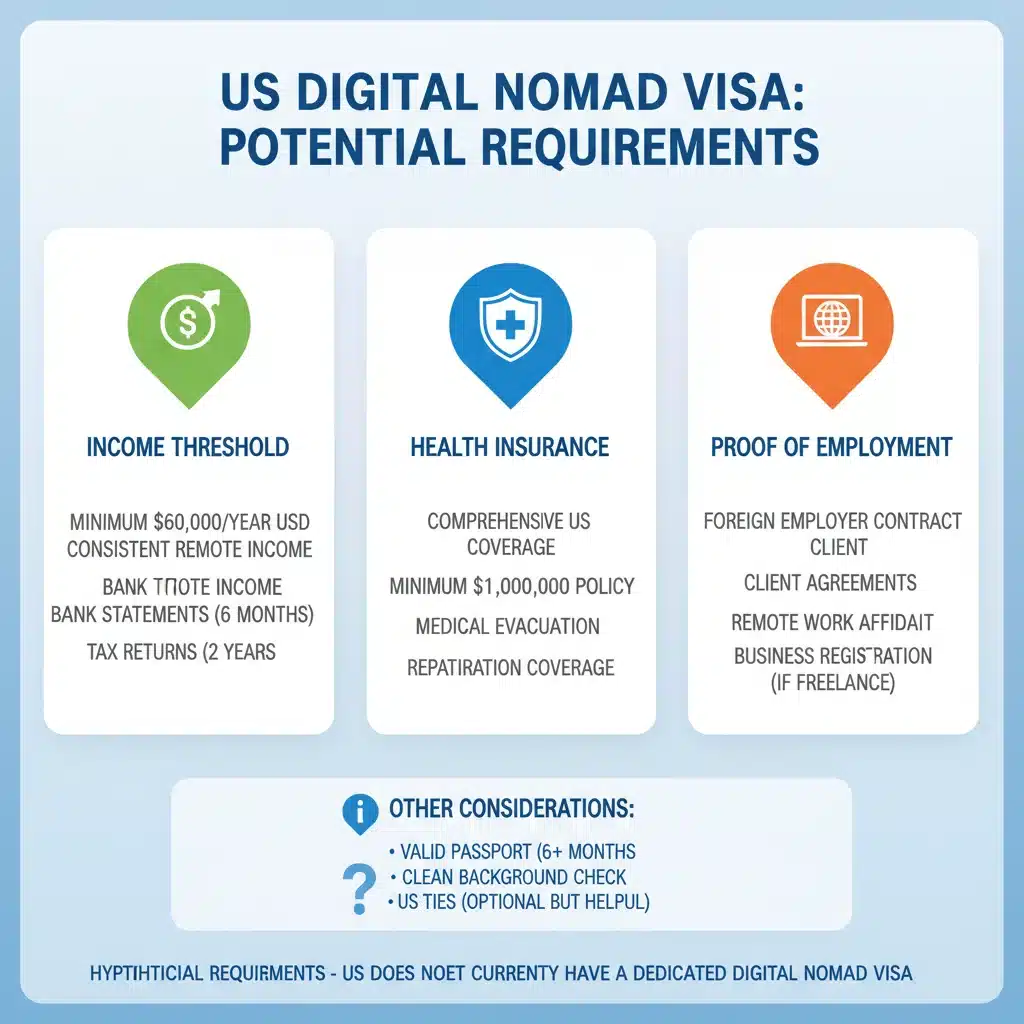
Based on global trends and discussions, an expert forecast for a potential US Digital Nomad Visa in 2026 would likely include several key features:
1. Income Requirements
Like most digital nomad visas globally, a U.S. version would almost certainly have a minimum income requirement. This is to ensure that applicants are self-sufficient and do not become a burden on public resources. Given the higher cost of living in many parts of the U.S., this threshold would likely be higher than in other countries. Experts predict an annual income requirement of at least $60,000 to $100,000 USD, possibly higher depending on the region of intended stay.
2. Proof of Foreign Employment/Clientele
Applicants would need to demonstrate that they are employed by a company outside the U.S. or have a portfolio of foreign clients, and that their work can be performed remotely. This is crucial to distinguish digital nomads from those seeking traditional employment in the U.S. labor market.
3. Health Insurance
Access to affordable healthcare in the U.S. is a significant concern. It’s highly probable that a US Digital Nomad Visa would mandate comprehensive international health insurance coverage for the entire duration of the stay, ensuring nomads do not rely on the U.S. healthcare system without adequate coverage.
4. Clean Criminal Record
Standard for almost all U.S. visas, a clean criminal record would be a prerequisite.
5. Duration of Stay and Renewability
Most digital nomad visas offer initial stays of 1-2 years with options for renewal. A U.S. visa would likely follow a similar pattern, possibly offering an initial 12-month stay, renewable for another 1-2 years, with a cap on total duration to prevent it from becoming a de facto permanent residency pathway.
6. Application Process and Fees
The process would likely involve an online application, submission of supporting documents, and an interview at a U.S. embassy or consulate abroad. Application fees would be expected, potentially similar to other non-immigrant visa fees.
7. Tax Implications
This is one of the most complex aspects. The U.S. taxes based on citizenship and residency. Digital nomads spending significant time in the U.S. (e.g., more than 183 days under the substantial presence test) could become U.S. tax residents, even if their income is from foreign sources. Any legislation for a US Digital Nomad Visa would need to address these tax complexities clearly, potentially offering specific tax treaties or exemptions for qualifying individuals to make the visa truly attractive.
Challenges and Criticisms of a US Digital Nomad Visa
While the benefits are clear, a US Digital Nomad Visa would also face scrutiny and potential challenges:
1. Impact on Housing Markets
Critics might argue that an influx of digital nomads, particularly in popular cities, could exacerbate housing shortages and drive up rental costs, similar to debates seen in other digital nomad hotspots. Careful planning and consideration of regional distribution might be necessary.
2. ‘Brain Drain’ for Developing Countries
Some argue that digital nomad visas contribute to a ‘brain drain’ from developing countries, as skilled workers choose to live and work in wealthier nations. This is a broader ethical debate, but one that could be raised in policy discussions.
3. Security Concerns and Vetting
As with any new visa category, there would be concerns about security and the thorough vetting of applicants to prevent misuse or exploitation of the system.
4. Political Will and Immigration Stance
The biggest hurdle remains the political climate surrounding immigration in the U.S. Any new visa category, even one focused on economic benefits, will inevitably become part of the larger immigration debate.
Preparing for a Potential US Digital Nomad Visa in 2026
Even without a concrete visa in place, aspiring digital nomads can take steps to prepare for a future US Digital Nomad Visa:
- Build a Strong Remote Work Profile: Ensure you have a stable, verifiable remote income stream from non-U.S. sources.
- Maintain Excellent Financial Records: Be prepared to demonstrate your financial self-sufficiency with bank statements, tax returns from your home country, and contracts with clients/employers.
- Research Health Insurance Options: Look into international health insurance providers that offer comprehensive coverage in the U.S.
- Stay Informed: Follow immigration news from official U.S. government sources (USCIS, Department of State) and reputable immigration law firms. Policy changes can happen rapidly.
- Consider Professional Advice: If a visa is introduced, consulting with an immigration attorney specializing in U.S. law will be crucial.
The Broader Impact: What a US Digital Nomad Visa Means for the Future of Work
The introduction of a US Digital Nomad Visa would be more than just another immigration category; it would be a symbolic acknowledgment of the profound shift in how and where people work. It would signify that the U.S., traditionally a leader in global talent attraction, is adapting to the 21st-century workforce. Such a visa could:
- Catalyze Innovation: Bringing diverse talents and perspectives to the U.S., even temporarily, can foster cross-cultural collaboration and innovation.
- Promote Cultural Exchange: Digital nomads are often ambassadors of their cultures, enriching the communities they visit.
- Influence Global Policy: A U.S. digital nomad visa could set a precedent and influence other major economies to consider similar policies.
The U.S. has a unique opportunity to shape the future of global remote work mobility. By strategically implementing a US Digital Nomad Visa, it can attract a valuable demographic, boost its economy, and reinforce its position as a global leader in innovation and opportunity.
Conclusion: The Horizon for a US Digital Nomad Visa in 2026
While the path to a dedicated US Digital Nomad Visa remains challenging, the growing economic imperative, coupled with the global trend towards remote work, suggests that 2026 could be a pivotal year. The discussions are happening, the benefits are being weighed, and the U.S. is increasingly aware of the competitive landscape. While no guarantees can be made, the probability of some form of legal pathway for digital nomads to reside and work remotely in the United States by 2026 is higher than ever before.
Aspiring digital nomads should remain cautiously optimistic and proactive in preparing themselves for such an opportunity. The future of global mobility is evolving, and the U.S. appears poised to join the ranks of nations embracing this transformative movement. Keep a close watch on legislative developments and immigration news; the dream of working remotely from the vibrant landscapes of the United States might just become a reality sooner than you think.