Securing Your Smart Home: Essential U.S. Protocols for 2026

The dawn of 2026 brings with it an unprecedented level of connectivity within our homes. Smart homes, once a futuristic concept, are now a tangible reality for millions across the United States. From smart thermostats and lighting systems to advanced security cameras and voice assistants, these devices promise convenience, efficiency, and enhanced living. However, with great connectivity comes great responsibility, particularly regarding security. As our lives become intricately intertwined with these digital ecosystems, understanding and implementing robust Smart Home Security Protocols becomes not just advisable, but absolutely essential.
The landscape of smart home technology is constantly evolving, and so too are the threats. A breach in your smart home isn’t just an inconvenience; it can compromise your privacy, expose sensitive data, or even pose physical risks. This comprehensive guide will delve into the critical U.S. Smart Home Security Protocols that are shaping the industry in 2026, offering practical solutions and recent updates to ensure your connected sanctuary remains safe and sound.
The Evolving Threat Landscape for Smart Homes
Before we dive into the solutions, it’s crucial to understand the challenges. Cybercriminals are increasingly sophisticated, targeting vulnerabilities in smart devices, networks, and even user habits. Common threats include:
- Data Breaches: Unauthorized access to personal data collected by smart devices (e.g., location, usage patterns, video/audio recordings).
- Device Hijacking: Gaining control over smart devices to manipulate their functions, such as unlocking doors, disabling security systems, or misusing cameras.
- DDoS Attacks: Using compromised smart devices (botnets) to launch denial-of-service attacks against other targets.
- Privacy Invasion: Covert monitoring through smart cameras or microphones.
- Ransomware: Encrypting smart device data or locking users out of their systems until a ransom is paid.
The sheer number and variety of smart devices in a typical home create a vast attack surface. Each device, from a smart bulb to a complex home automation hub, represents a potential entry point for malicious actors. Therefore, a multi-layered approach to Smart Home Security Protocols is paramount.
Key U.S. Smart Home Security Protocols in 2026
The industry is moving towards greater standardization and enhanced security features. Several key protocols are at the forefront of this evolution, each bringing unique strengths to the table.
1. Matter: The Universal Language of the Smart Home
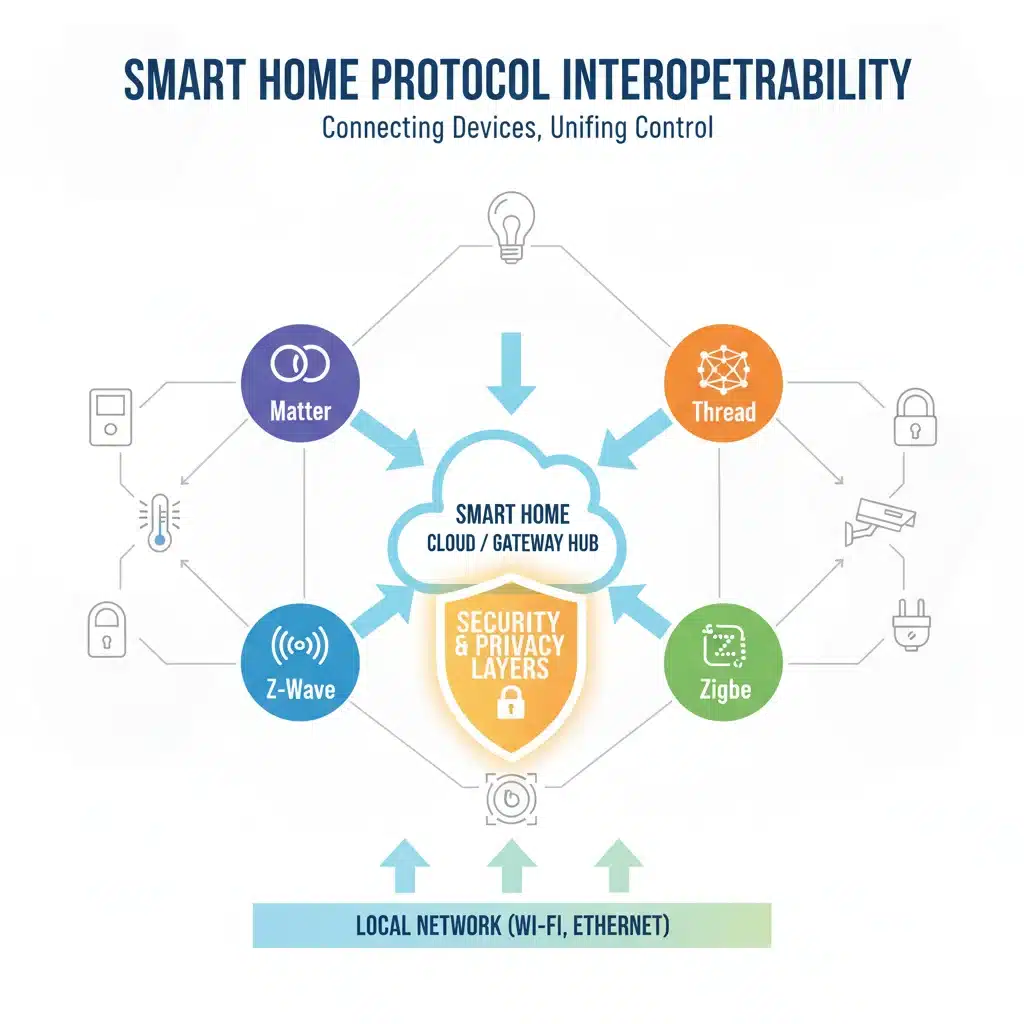
Matter, spearheaded by the Connectivity Standards Alliance (CSA), is arguably the most significant development in smart home technology. It’s not a wireless protocol itself, but an application layer standard built on top of existing IP-based technologies like Wi-Fi, Thread, and Ethernet. Its primary goal is interoperability, allowing devices from different manufacturers to communicate seamlessly. However, its impact on Smart Home Security Protocols is equally profound.
Security Features of Matter:
- Device Attestation: Ensures that only authentic, certified Matter devices can join the network, preventing rogue devices from being introduced.
- Secure Commissioning: The process of adding new devices to a Matter network is highly secured, often involving QR code scanning and cryptographic key exchange.
- End-to-End Encryption: All communications between Matter devices and controllers are encrypted, protecting data in transit.
- Access Control: Granular control over which devices and users can access specific functions and data.
- Regular Security Updates: The open-source nature and broad industry support mean that vulnerabilities are likely to be identified and patched quickly.
For consumers, Matter simplifies security by reducing fragmentation. Instead of managing multiple apps and security settings for different brands, Matter aims to unify the experience under a single, secure framework. This greatly enhances the overall effectiveness of Smart Home Security Protocols.
2. Thread: The Wireless Mesh Network for IoT
Thread is an IP-based, low-power wireless mesh networking protocol designed specifically for IoT devices. It’s a foundational technology for Matter, providing the underlying network layer for many Matter-enabled devices. Thread’s mesh architecture means that devices can communicate directly with each other, forming a robust and self-healing network.
Security Features of Thread:
- AES-128 Encryption: All network traffic is encrypted using Advanced Encryption Standard (AES) with 128-bit keys, a strong cryptographic algorithm.
- Authentication: Devices must be authenticated before joining a Thread network, preventing unauthorized access.
- No Single Point of Failure: The mesh network design inherently improves security by decentralizing communication. If one device is compromised, it doesn’t necessarily bring down the entire network.
- Secure Commissioning: Similar to Matter, Thread employs secure methods for adding new devices, often involving cryptographic keys.
Thread’s focus on reliability and security at the network layer makes it an indispensable component of modern Smart Home Security Protocols, especially for battery-powered devices where Wi-Fi might be too power-intensive.
3. Z-Wave: The Established Leader in Home Automation
Z-Wave has been a dominant force in home automation for years, known for its reliability and low-power consumption. It operates on a different radio frequency (908.42 MHz in the U.S.) than Wi-Fi, reducing interference and offering a dedicated communication channel for smart home devices. While not directly compatible with Matter (without a bridge), Z-Wave continues to be a robust option for many users.
Security Features of Z-Wave:
- S2 Security Framework: Z-Wave’s S2 (Security 2) framework is a significant enhancement, providing advanced security features.
- AES-128 Encryption: S2 mandates AES-128 encryption for all communications.
- Authenticated Key Exchange: Securely establishes keys during device pairing, preventing man-in-the-middle attacks.
- Device-Specific Keys: Each device has a unique, cryptographically derived key, enhancing isolation.
- Audit Trails: Many Z-Wave controllers offer logging capabilities, helping identify unusual activity.
The Z-Wave Alliance actively promotes security best practices and ensures that certified devices meet strict security standards, making it a reliable choice for Smart Home Security Protocols.
4. Zigbee: Another Veteran in the Smart Home Arena
Zigbee is another long-standing wireless protocol for smart homes, known for its mesh networking capabilities and low power consumption. It operates on the 2.4 GHz band, similar to Wi-Fi, but uses a different set of channels to minimize interference. Many popular smart home devices, particularly lighting and sensors, utilize Zigbee.
Security Features of Zigbee:
- AES-128 Encryption: Zigbee networks employ AES-128 encryption to secure communications.
- Network Keys and Link Keys: Uses a combination of network-wide keys and unique link keys for point-to-point encryption.
- Trust Center: A central device (often the hub) acts as a ‘Trust Center,’ responsible for authenticating and managing security keys for devices joining the network.
- Over-the-Air (OTA) Updates: Allows for secure firmware updates to patch vulnerabilities.
While Zigbee has a strong security foundation, its implementation can vary between manufacturers. Choosing devices from reputable brands and ensuring your hub is up-to-date is crucial for maximizing Zigbee’s Smart Home Security Protocols.
5. Wi-Fi: The Ubiquitous Connector
Wi-Fi is the most common wireless technology in our homes, and many smart devices connect directly to it. While convenient, Wi-Fi’s broad adoption also makes it a prime target for attackers. Securing your Wi-Fi network is the foundational layer for any Smart Home Security Protocols.
Essential Wi-Fi Security Practices:
- Strong WPA3 Encryption: Always use WPA3 (Wi-Fi Protected Access 3) for your home network. If your router doesn’t support WPA3, use WPA2-AES. Avoid WEP and WPA/WPA2-TKIP.
- Strong, Unique Passwords: Use complex, unique passwords for your Wi-Fi network and change them regularly.
- Guest Network: Set up a separate guest Wi-Fi network for smart devices that don’t need access to your main network (e.g., smart light bulbs, smart plugs). This isolates them from your personal computers and sensitive data.
- Router Firmware Updates: Keep your router’s firmware updated to patch security vulnerabilities.
- Disable WPS: Wi-Fi Protected Setup (WPS) can be vulnerable to brute-force attacks; disable it if not absolutely necessary.
- Firewall: Ensure your router’s firewall is enabled and configured correctly.
Even with Matter and Thread gaining traction, Wi-Fi will remain a critical backbone for many smart home devices. A weak Wi-Fi network compromises all connected devices, regardless of their individual protocol’s security features.
Practical Solutions for Implementing Robust Smart Home Security Protocols
Understanding the protocols is just the first step. Implementing them effectively requires a proactive approach. Here are practical solutions for enhancing your Smart Home Security Protocols:
1. The Central Role of Your Smart Home Hub
Many smart homes rely on a central hub (e.g., Apple HomePod, Amazon Echo, Google Nest Hub, SmartThings, Hubitat). This hub often acts as the bridge between different protocols and your internet connection. Therefore, securing your hub is paramount.
- Choose Reputable Hubs: Invest in hubs from well-known manufacturers with a strong track record of security updates and support.
- Keep Hub Firmware Updated: Enable automatic updates or manually check for and install the latest firmware.
- Strong Password and Multi-Factor Authentication (MFA): Protect access to your hub’s app and settings with strong, unique passwords and enable MFA wherever possible.
- Review Permissions: Regularly review what permissions your hub and connected apps have. Limit access to only what’s necessary.
2. Device-Level Security Best Practices
Each smart device is a potential vulnerability. Treat each one with a security-first mindset.
- Change Default Passwords: This is non-negotiable. Many devices come with default credentials that are easily guessable or publicly known. Change them immediately to strong, unique passwords.
- Enable Multi-Factor Authentication (MFA): For any device or app that supports it (e.g., smart door locks, security cameras), enable MFA.
- Regular Firmware Updates: Manufacturers frequently release firmware updates to patch security flaws. Enable automatic updates or check manually.
- Privacy Settings: Review and configure privacy settings on all devices. Limit data collection and sharing where possible. For example, disable microphones on smart speakers when not in use if you’re concerned about always-on listening.
- Physical Security: Ensure physical access to your devices is restricted. For example, don’t leave smart home control panels in easily accessible, unsecured locations.
- "Need-to-Know" Connectivity: Only connect devices to the internet that absolutely require it for their functionality. Some simple smart devices might work locally without internet access.
3. Network Segmentation and Isolation
Network segmentation involves dividing your home network into smaller, isolated segments. This is a highly effective Smart Home Security Protocols strategy.
- Guest Network for IoT: As mentioned for Wi-Fi, create a separate guest network specifically for your smart devices. This prevents a compromised IoT device from accessing your main network where your computers, phones, and sensitive files reside.
- VLANs (Virtual Local Area Networks): For advanced users, setting up VLANs can provide even greater isolation, creating distinct virtual networks for different categories of devices (e.g., one for IoT, one for personal devices, one for guests).
- IoT-Specific Routers: Some routers are now designed with dedicated IoT networks and enhanced security features.
4. Data Privacy and Encryption
Beyond network security, protecting the data generated and transmitted by your smart devices is crucial.
- Understand Data Policies: Before purchasing a smart device, read the manufacturer’s data privacy policy. Understand what data is collected, how it’s used, and whether it’s shared with third parties.
- End-to-End Encryption: Prioritize devices and services that offer end-to-end encryption for sensitive data, especially for cameras and voice recordings.
- Cloud Storage Security: If your devices store data in the cloud (e.g., security camera footage), ensure the cloud provider has robust security measures, including encryption at rest and in transit.
- Data Minimization: Configure devices to collect and store only the data essential for their operation.
5. Regular Audits and Monitoring
Security is not a one-time setup; it’s an ongoing process.
- Regular Security Audits: Periodically review your smart home setup. Check device settings, network configurations, and app permissions.
- Monitor Network Activity: Some advanced routers or network monitoring tools can alert you to unusual network traffic from your smart devices.
- Stay Informed: Keep up-to-date with smart home security news and potential vulnerabilities related to your specific devices and protocols.
- Consider Professional Assistance: For complex smart home setups or if you have significant security concerns, consider consulting a cybersecurity professional.
The Future of Smart Home Security: What to Expect Beyond 2026
The trajectory for Smart Home Security Protocols points towards even greater integration, automation, and proactive defense mechanisms. Here’s what we might see on the horizon:
- AI and Machine Learning for Anomaly Detection: More widespread use of AI to learn normal device behavior and automatically flag suspicious activities, potentially even blocking threats before they materialize.
- Decentralized Security Models: Leveraging blockchain or similar decentralized technologies for immutable audit trails and enhanced identity management for devices.
- Hardware-Level Security: Greater emphasis on secure hardware enclaves and trusted execution environments within devices to protect cryptographic keys and sensitive operations.
- Government and Industry Standards: Increased regulatory oversight and mandatory security certifications for smart devices, similar to existing standards in other critical infrastructure sectors. The U.S. government is already taking steps in this direction.
- Self-Healing Networks: Networks that can automatically detect, isolate, and remediate compromised devices without user intervention.
- Enhanced User Education: As technology advances, so too must user awareness and education regarding best practices for Smart Home Security Protocols.
The focus on Matter and Thread is a clear indication that the industry is striving for a more unified and inherently secure ecosystem. These protocols, by design, bake in security features that were often add-ons or afterthoughts in earlier generations of smart devices. This shift from fragmented, proprietary systems to open, secure standards is a massive win for consumer security.
Addressing Common Misconceptions About Smart Home Security
Many users harbor misconceptions that can inadvertently compromise their smart home security:
- "My smart home is too small to be a target." Cybercriminals often use automated scans to find vulnerabilities. Your home doesn’t need to be high-profile to be attacked.
- "I only buy from big brands, so I’m safe." While reputable brands generally offer better security, no system is 100% impenetrable. Vigilance and proper configuration are always necessary.
- "Updating firmware is a hassle." Firmware updates are critical security patches. Neglecting them leaves your devices vulnerable.
- "My Wi-Fi password is good enough." A strong Wi-Fi password is essential, but it’s only one layer. Device-specific passwords and network segmentation add crucial additional protection.
- "My smart devices don’t store sensitive data." Many devices collect usage patterns, presence detection, and even audio/video, which can be highly sensitive in the wrong hands.
Dispelling these myths and adopting a proactive security posture is fundamental to truly leveraging the benefits of a smart home without sacrificing peace of mind.
Conclusion: A Secure Smart Home is an Empowered Home
As we navigate the increasingly connected world of 2026, the importance of robust Smart Home Security Protocols cannot be overstated. By understanding the foundational technologies like Matter, Thread, Z-Wave, Zigbee, and Wi-Fi, and by diligently applying practical security measures, homeowners can create a resilient and privacy-respecting smart environment.
The future of smart home living is bright, filled with possibilities for comfort, efficiency, and safety. But this future is only truly realized when security is woven into its very fabric. Invest in secure devices, maintain vigilant network practices, and stay informed about the latest threats and solutions. Your smart home is an extension of your life; protect it with the same care you would any other valuable asset. An empowered home is one where technology serves you securely, without compromise.
By embracing these protocols and practices, you’re not just protecting your devices; you’re safeguarding your digital life, your privacy, and ultimately, your peace of mind in the smart home of today and tomorrow.