Space Commercialization: 4 Emerging Business Models Beyond Satellite Launches in 2026
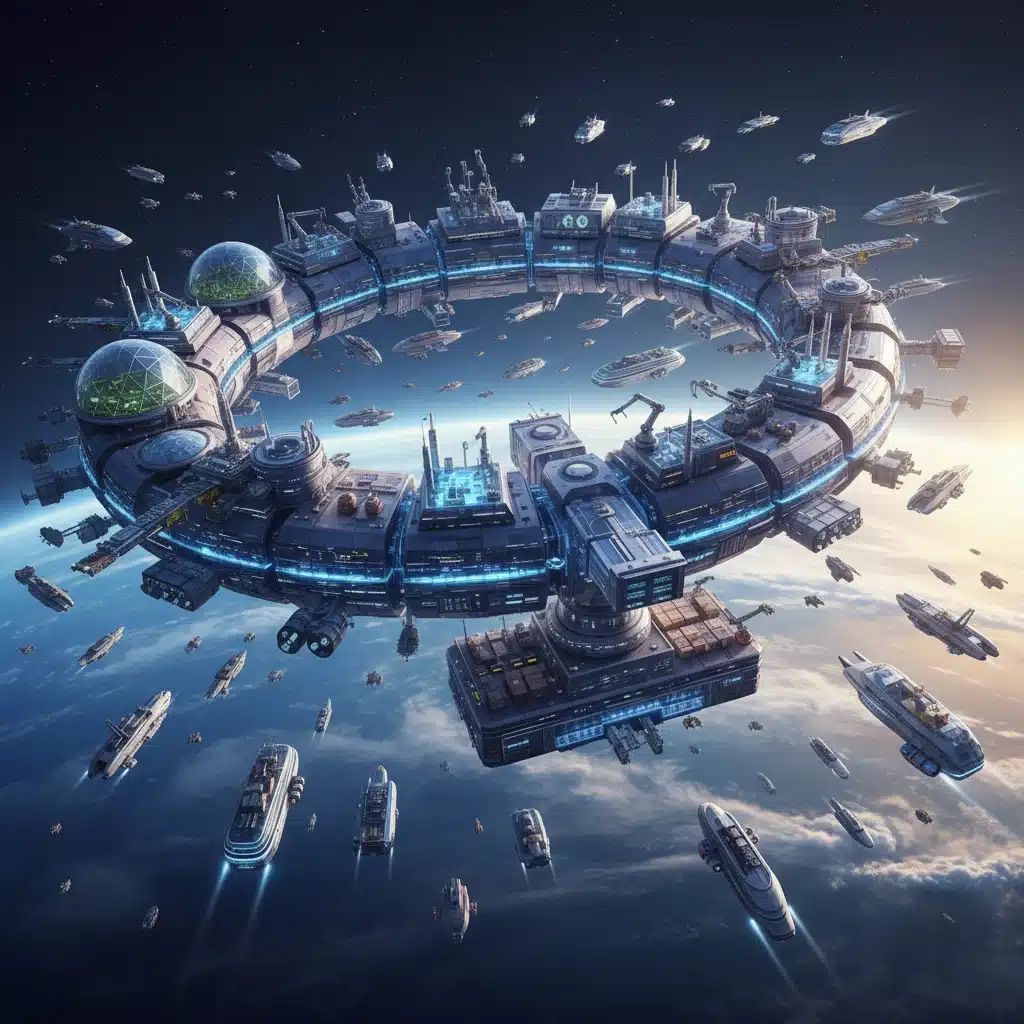
Space Commercialization: 4 Emerging Business Models Beyond Satellite Launches in 2026
The dawn of a new space age is upon us, characterized not just by governmental missions and scientific exploration, but by a burgeoning commercial sector. For decades, the space industry was synonymous with colossal government-funded projects and the launch of communication satellites. While satellite launches remain a critical component, the landscape of space commercialization business models is rapidly expanding, driven by technological advancements, decreasing costs, and an entrepreneurial spirit. We are entering an era where space is no longer just a destination for scientific curiosity but a vibrant arena for economic growth and innovation.
By 2026, the global space economy is projected to reach unprecedented heights, with a significant portion of this growth stemming from novel and often disruptive business models that extend far beyond simply putting payloads into orbit. These emerging models are not just hypothetical; they are actively being developed, funded, and pursued by a diverse array of startups and established corporations alike. Understanding these evolving space commercialization business models is crucial for investors, entrepreneurs, and policymakers aiming to capitalize on the next frontier of economic development.
This article will delve into four key space commercialization business models that are set to redefine the industry by 2026. We will explore their potential, the challenges they face, and the innovative companies leading the charge. From in-orbit manufacturing to lunar resource extraction, these models represent a paradigm shift, transforming our perception of space from an inaccessible void to a dynamic marketplace. Prepare to journey into the future of the space economy, where the possibilities are as boundless as the cosmos itself.
1. In-Orbit Manufacturing and Servicing: The Orbital Factory Floor
One of the most transformative space commercialization business models emerging is in-orbit manufacturing and servicing (IOS). Traditionally, everything launched into space had to withstand the immense stresses of launch and fit within the limited volume and mass constraints of a rocket fairing. This often meant designing smaller, more robust components that were built on Earth and then painstakingly assembled in space, if at all. IOS flips this paradigm, proposing that certain products and structures can be more efficiently, cost-effectively, and even exclusively manufactured or maintained directly in orbit.
The Promise of In-Orbit Manufacturing
The advantages of in-orbit manufacturing are multifold. Firstly, it bypasses the need to design components to withstand launch forces, allowing for the creation of much larger, more delicate, and optimized structures. Imagine colossal antenna arrays, massive solar power satellites, or even entire space habitats assembled in microgravity, free from atmospheric drag and gravitational stresses. This opens up possibilities for bespoke materials and intricate designs previously unfeasible. Companies like Made In Space (now part of Redwire) have already demonstrated 3D printing in orbit, creating tools and components on the International Space Station (ISS).
Furthermore, in-orbit manufacturing can leverage the unique conditions of space. The vacuum, microgravity, and extreme temperatures can be harnessed to create novel materials with properties impossible to achieve on Earth. For instance, growing ultra-pure crystals or manufacturing advanced fiber optics in microgravity can yield superior products for terrestrial applications, creating a high-value export market from space to Earth. This niche but lucrative segment is a key driver for this space commercialization business model.
The Rise of In-Orbit Servicing
Complementing manufacturing is in-orbit servicing. The current model for satellites often involves launching expensive, complex machines with a finite lifespan. Once they run out of fuel, experience a malfunction, or become obsolete, they are typically decommissioned or sent to a graveyard orbit. In-orbit servicing aims to change this by providing repair, refueling, upgrade, and even relocation services for satellites. This extends the operational life of valuable space assets, reduces the need for costly replacement launches, and minimizes space debris.
Companies like Northrop Grumman’s SpaceLogistics and Astroscale are pioneering this field. SpaceLogistics’ Mission Extension Vehicle (MEV) has successfully docked with and extended the life of commercial satellites. Astroscale focuses on active debris removal and end-of-life services, ensuring a sustainable space environment. These services are becoming increasingly vital as the number of satellites in orbit continues to skyrocket, making IOS a foundational space commercialization business model for future space infrastructure.
Challenges and Future Outlook
While promising, IOS faces challenges including high development costs, the complexity of robotic operations in space, and regulatory hurdles. However, as technology matures and the demand for in-space assets grows, the economic rationale for IOS becomes increasingly compelling. By 2026, we can expect to see more sophisticated orbital factories, advanced robotic repair missions, and specialized servicing vehicles becoming commonplace, solidifying IOS as a cornerstone of the new space economy.
2. Lunar Resource Extraction and Utilization: Fueling the Future Off-World
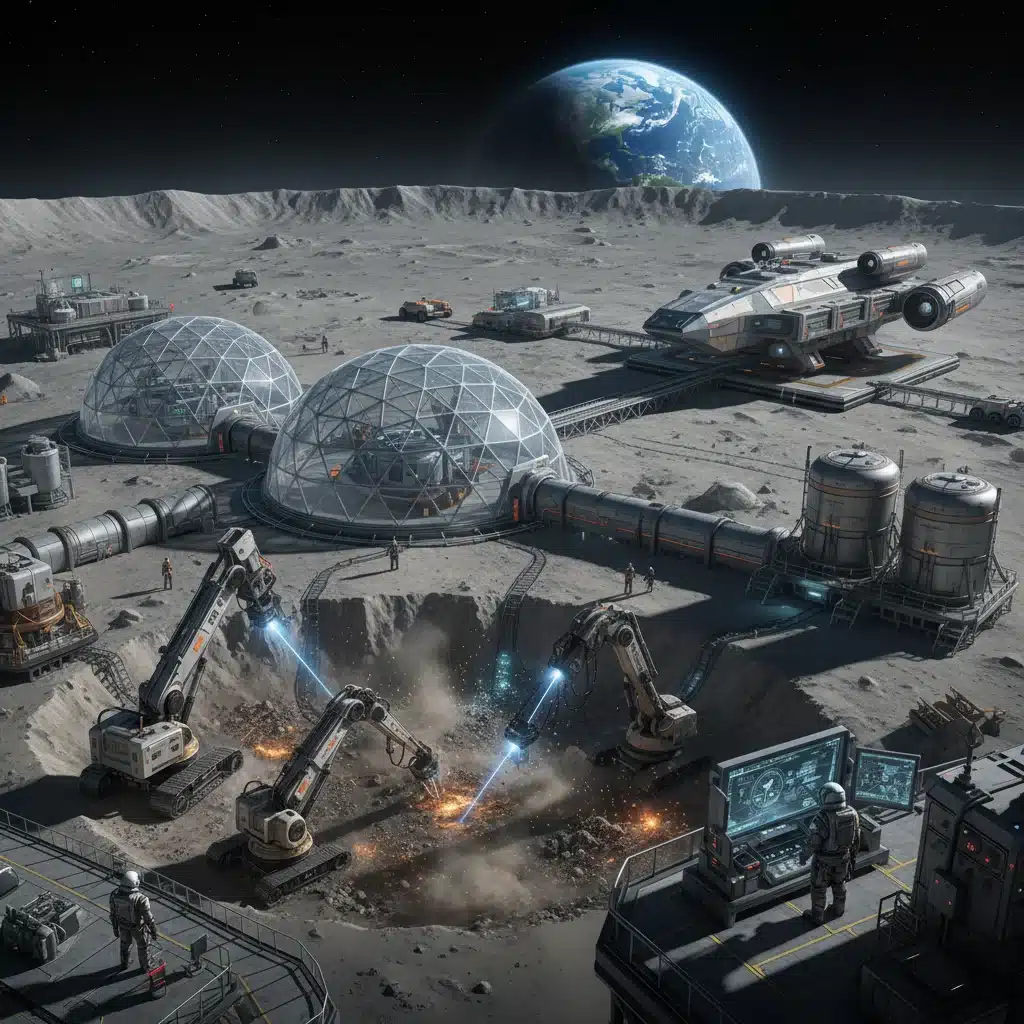
The Moon, long viewed as a distant celestial body, is rapidly transforming into a strategic outpost and a potential wellspring of resources. Lunar resource extraction and utilization (ISRU – In-Situ Resource Utilization) represent another groundbreaking space commercialization business model with profound implications for sustained human presence beyond Earth. The Moon is believed to harbor significant quantities of water ice, particularly in its permanently shadowed craters at the poles, as well as rare earth elements, helium-3, and other valuable minerals.
The Quest for Lunar Water Ice
Water ice is perhaps the most critical resource on the Moon. It can be used for drinking water, life support systems, and crucially, it can be split into hydrogen and oxygen – the primary components of rocket fuel. This means that future missions to Mars or deeper into the solar system could refuel at lunar depots, significantly reducing the cost and mass required for launches from Earth. The concept of ‘propellant depots’ on the Moon or in lunar orbit is a game-changer, fundamentally altering the economics of deep space travel and making lunar resource extraction a pivotal space commercialization business model.
Companies like Intuitive Machines, Astrobotic, and Masten Space Systems (though Masten has faced financial challenges, the concept remains valid) are actively developing lunar landers and rovers designed to explore and characterize these resources. NASA’s Artemis program, with its goal of returning humans to the Moon and establishing a sustainable presence, is a major driver for this commercial activity, creating a market for lunar resource providers.
Mining for Rare Earths and Helium-3
Beyond water, the Moon’s regolith (lunar soil) is thought to contain valuable minerals and elements. Rare earth elements are vital for modern electronics and green technologies, and while terrestrial supplies are concentrated in a few regions, lunar mining could provide alternative sources. Helium-3, a light, non-radioactive isotope, is another highly sought-after resource. It is extremely rare on Earth but relatively abundant on the Moon, deposited by solar winds over billions of years. Helium-3 is considered a potential fuel for future nuclear fusion power plants, offering a clean and powerful energy source. While the technology for helium-3 fusion is still in its infancy, the long-term potential makes its extraction an appealing space commercialization business model.
Establishing a Lunar Economy
The development of lunar resource extraction capabilities is not just about bringing materials back to Earth; it’s about building a self-sustaining lunar economy. This includes manufacturing structures and habitats using lunar regolith (regolith 3D printing), producing oxygen for life support, and creating propellants for in-space transportation. Such an economy would drastically reduce the reliance on Earth-launched supplies, making lunar bases and future deep space missions far more feasible and affordable. By 2026, we anticipate significant strides in lunar ISRU demonstrations, laying the groundwork for a truly off-world industrial presence.
3. Space Tourism and Commercial Habitats: The Ultimate Getaway
What was once the exclusive domain of science fiction is rapidly becoming a tangible reality: space tourism. While initial offerings have been suborbital joyrides, the next phase of this space commercialization business model involves orbital tourism and the development of commercial space habitats where individuals can live, work, and vacation beyond Earth. This sector is driven by a growing appetite for unique, experiential travel and the decreasing costs of access to space.
Suborbital and Orbital Tourism
Companies like Virgin Galactic and Blue Origin have already begun offering suborbital flights, allowing passengers to experience a few minutes of weightlessness and witness the curvature of the Earth from the edge of space. While expensive, the demand for these experiences is high. The next step is orbital tourism, exemplified by companies like SpaceX, which has already facilitated private missions to the ISS and plans for future private orbital flights. These experiences offer longer durations in space, allowing for more extensive zero-gravity activities and breathtaking views of our planet.
As launch costs continue to fall and technology advances, the price point for space tourism is expected to become more accessible, albeit still premium. This expansion will create a robust market for support services, specialized training, and unique in-space experiences, making space tourism a rapidly maturing space commercialization business model.
Commercial Space Habitats and Hotels
Beyond short visits, the concept of commercial space habitats and hotels is gaining traction. Companies like Axiom Space are developing modules that will attach to the ISS, eventually forming a standalone commercial space station. Others, like Orbital Assembly Corporation, are proposing much larger, rotating space stations designed to generate artificial gravity, offering longer-term stays for tourists, researchers, and even permanent residents. These habitats would provide comfortable living quarters, scientific laboratories, and entertainment facilities, creating a truly unique environment.

The development of such habitats requires significant investment in life support systems, radiation shielding, power generation, and waste management. However, the potential market for long-duration stays, scientific research platforms, and even manufacturing facilities within these habitats is enormous. By 2026, we may see the initial modules of these commercial space stations becoming operational, marking a pivotal moment for this space commercialization business model.
Challenges and Ethical Considerations
While exciting, space tourism and commercial habitats face challenges related to safety, radiation exposure, psychological effects of long-duration spaceflight, and the immense cost of construction and operation. Ethical considerations regarding who gets access to space and the potential for space debris also need careful consideration. Despite these hurdles, the allure of space remains a powerful motivator, driving innovation and investment in this sector.
4. Space-Based Solar Power (SBSP) and Energy Transmission: Powering Earth from Orbit
As global energy demand continues to rise and the imperative to transition to clean energy sources becomes more urgent, space-based solar power (SBSP) emerges as a highly ambitious yet potentially transformative renewable energy space commercialization business model. SBSP involves collecting solar energy in space, where it is unaffected by atmospheric conditions, day-night cycles, or weather, and then wirelessly transmitting it to Earth.
The Concept of Space-Based Solar Power
The idea behind SBSP is elegant: large solar arrays in geostationary orbit (GEO) or other high orbits would continuously capture sunlight. This energy would then be converted into microwaves or lasers and beamed down to receiving stations (rectennas) on Earth. Since the satellites are in constant sunlight, they can generate power 24/7, offering a reliable, baseload clean energy source that complements intermittent terrestrial renewables like ground-based solar and wind.
The United States, China, Japan, and the European Space Agency are all actively pursuing SBSP research. Projects like the California Institute of Technology’s Space Solar Power Project (SSPP) have already demonstrated wireless power transmission in space, a critical step toward realizing this vision. The sheer scale and continuous output of SBSP could revolutionize global energy grids, making it a potentially colossal space commercialization business model.
Advantages and Technical Hurdles
The advantages of SBSP are significant: constant power generation, no carbon emissions during operation, minimal land footprint on Earth compared to terrestrial solar farms, and the ability to direct power to regions most in need. However, the technical hurdles are immense. They include the construction and deployment of massive solar arrays in space (potentially kilometers in size), efficient and safe wireless power transmission over vast distances, and the economic viability of such large-scale infrastructure. The cost of launching the necessary components into orbit is currently a major barrier.
However, advancements in launch technology (e.g., reusable rockets) and in-orbit manufacturing (as discussed in Model 1) are gradually making SBSP more feasible. If the cost of access to space continues to decrease, and if energy transmission efficiency improves, SBSP could become economically competitive with traditional power sources. By 2026, we expect to see continued progress in demonstration missions, potentially leading to pilot projects that validate the technical and economic aspects of this ambitious space commercialization business model.
Energy Transmission and Infrastructure
Beyond the solar arrays themselves, the development of robust energy transmission infrastructure, both in space and on Earth, is crucial. This includes designing highly efficient microwave or laser transmitters, ensuring beam safety and precision, and building large-scale rectenna arrays that can convert the beamed energy back into electricity for grid integration. The regulatory frameworks for such transnational energy transfer will also need to be established. The long-term vision for SBSP is a global network of space-based power plants contributing significantly to Earth’s energy needs, securing its place as a future-defining space commercialization business model.
The Broader Impact of Space Commercialization Business Models
These four emerging space commercialization business models are not isolated ventures; they are interconnected and mutually reinforcing. For example, in-orbit manufacturing could be used to build the large solar arrays for SBSP or the modules for commercial space habitats. Lunar resource extraction could provide propellant for missions to larger orbital facilities or for further exploration. The synergies between these models create a powerful ecosystem that accelerates the overall growth of the space economy.
The expansion of space commercialization business models also has profound implications for terrestrial industries. New technologies developed for space applications – from advanced materials and robotics to artificial intelligence and life support systems – often find their way back to Earth, driving innovation and creating new markets. The demand for skilled labor in space-related fields will also increase, fostering educational and career opportunities.
Investment and Regulatory Landscape
Investment in the space sector is surging, with venture capitalists and private equity firms increasingly recognizing the long-term potential of these emerging space commercialization business models. However, the regulatory environment is still catching up. International treaties like the Outer Space Treaty provide a foundational framework, but more specific national and international regulations are needed to govern resource ownership, debris mitigation, safety standards for space tourism, and intellectual property in orbit. Clear and stable regulatory frameworks will be essential to foster continued investment and ensure responsible development of the space economy.
Conclusion: A New Frontier of Opportunity
By 2026, the space industry will look dramatically different from what it is today. While satellite launches will remain vital, the true dynamism will come from the innovative space commercialization business models that are pushing the boundaries of what is possible. In-orbit manufacturing and servicing, lunar resource extraction, space tourism and commercial habitats, and space-based solar power each represent immense opportunities for economic growth, technological advancement, and human expansion.
These ventures are not without their challenges, from technical complexities and high initial costs to regulatory ambiguities. However, the rapid pace of innovation, coupled with a global appetite for space-derived services and products, suggests that these models are poised for significant maturation and impact in the coming years. As we look towards 2026 and beyond, the commercialization of space promises to unlock a new era of prosperity and discovery, fundamentally transforming our relationship with the cosmos and creating a truly boundless economy.
The future of the space economy is not just about reaching for the stars; it’s about building sustainable, profitable enterprises among them. The four space commercialization business models discussed here are merely the tip of the iceberg, representing the vanguard of a new industrial revolution that extends far beyond Earth’s atmosphere. The journey has just begun, and the opportunities are truly astronomical.